
Is La Plagne good for beginners?
Is La Plagne a good beginner resort?
Is La Plagne a good resort to learn skiing or snowboarding? Yes. Thanks to loads of low-gradient pistes, beginner zones in every main village and an easy progression route onto great easy-going blues, La Plagne is one of the best places in the Alps to learn skiing or snowboarding.
If you’re starting out skiing or snowboarding, your choice of resort is one of the biggest factors in how quickly you progress and how much you enjoy your week. Compared to many ski areas, La Plagne is a brilliant pick for beginners because it has so many gentle pistes and calm learning spaces. Note: La Plagne 360 guides are human-written, not generated by ChatGPT or similar AI software.
Affiliations: La Plagne 360 works with trusted, industry-leading suppliers to bring you the best services for your trip. If you click on these links, we may earn a small commission at no extra cost to you. In most cases, you’ll also benefit from a better deal. We only feature products and services we’ve used and genuinely recommend.
Quick tips for La Plagne beginners
Just a few reasons why La Plagne is a great resort for beginners: La Plagne is one of the easiest places in the Alps to learn skiing or snowboarding. The resort has free beginner lifts, calm learning zones in every main village and loads of friendly greens and blues once you’re ready to explore.
- Beginner-friendly by design: gentle pistes and proper learning areas across the resort
- Free beginner lifts: “zone débutants” magic carpets are free for absolute beginners
- Easy progression: once you can control speed and sideslip, La Plagne’s blues open up fast
- Best bases for novices: Plagne Centre, Bellecôte, Aime 2000 and Montalbert
- Watch-outs: a few blues start steeper than you’d expect (Mira and Verdons are the classic ones)
Simple plan: start in a beginner zone for 1–2 sessions, then move onto a gentle blue once you can sideslip in control.
La Plagne beginner essentials
Are beginner lifts free?
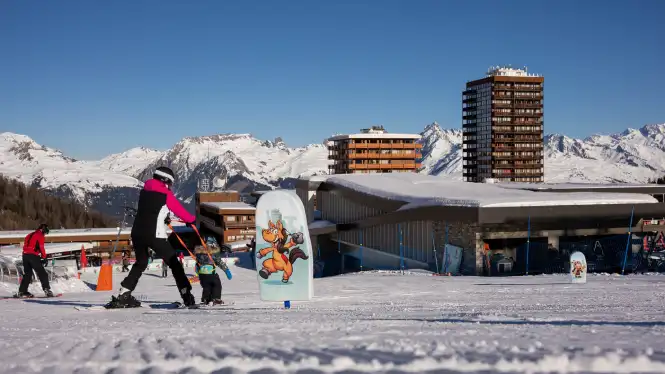
Free beginner zones: Absolute beginner lifts are free and usually run as magic carpets (snow travelators). The areas are typically roped-off, calmer than main pistes and designed for learning safely.
Where should I start?
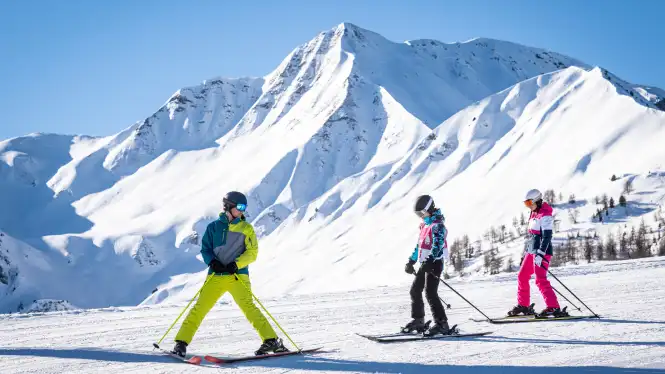
Your plan to get started: Do 1–2 short sessions on a magic carpet area to get stopping and balance sorted. Once you can control speed, step onto an easy green. Don’t rush the first “proper” piste. Learning takes patience, commitment and time.
When can I try a blue?
Your route to progression: Plenty of La Plagne blues are wide and forgiving, but the key skill is being able to sideslip calmly if a section feels steep or busy. That’s your safety brake. Other skills will soon follow.
Any pistes to be cautious of?
Advice for absolute beginners in La Plagne
Your biggest tip. Get lessons. YouTube videos help but they can’t replace one-on-one instruction: First things first — if you’re a total beginner (with zero snow experience), it’s well worth taking a few lessons at home before your trip if you can. A local dry slope or indoor snowdome isn’t the same as the mountains, but it does an excellent job of helping you find your balance and confidence.
If you can nail the basics of stopping, sideslipping and simple turns in advance, you’ll save precious holiday time and progress onto proper pistes much sooner. If possible, taking your first lessons at home is one of the best investments you can make.
If that’s not an option, don’t worry. La Plagne has great ski / snowboard schools and very good beginner areas in all the main villages, clearly marked as green runs on the piste map and usually set apart from faster traffic. These calm learning zones are designed specifically for first-timers.
One final tip: lessons help at every stage. Whether you’re brand new or already finding your feet, a few professional pointers will dramatically speed up your progress and help you avoid bad habits early on.
Best absolute beginner areas
Plagne Centre, Villages and Soleil
Central beginner zones: Plagne Centre has lots of great beginner spots, including areas around the Boulevard chair and the Indiens zone just up from the Funiplagne gondola. Plagne Villages has the short green Biquet. Soleil is also handy for gentle practice at the side of the Écartée blue and the Dou du Praz lift.
Plagne Bellecôte and Belle Plagne
Learning zones in the Bellecôte valley: Bellecôte’s main beginner zone sits just above the village with a magic carpet (Ourson). Belle Plagne’s easiest learning area (Belle Plagne TP) is near the top of the village by the Tyrolien drag lift. As you progress, there’s another great area at the top of the Arpette lift – the Ange – but you’ll need a pass to reach this lift.
Plagne Aime 2000
Aime 2000 – one of La Plagne’s best beginner areas: The main beginner zone is behind the building served by the Téléski Aime 2000 drag lift. There’s also another gentle area near the top of the Golf chair when you’re ready for slightly longer practice runs. Compared to other beginner zones, Aime offers spectacular views you simply won’t get lower down.
Plagne 1800
Plagne 1800 – a perfect, quiet beginner zone: The beginner area in Plagne 1800 sits close to the village and is served by a slow lift (the Praconduit drag) and a (normally) quiet piste – both of which are ideal for first-day confidence building.
Plagne Montalbert
Plagne Montalbert – low and high-level beginner options: Montalbert’s large Front de Neige offers the main beginner zone just above the village including the Montalbert drag lift. There’s also a second beginner area at the top of the Montalbert gondola, which is great for confidence once you’ve moved beyond the nursery slope. The short Grenouilles drag lift has the benefit of big mountain views (you’ll need a pass to access).
Montchavin, Champagny and La Roche
The valley resorts tend to have smaller, more weather-prone beginner setups: Montchavin has a short beginner area near the base of the Montchavin chairlift and another learning space at the top of the Plan Bois gondola. Champagny has a small village-level beginner spot (mostly aimed at kids), but the better learning zone is higher up around Aiglon and the excellent Éterlou. La Roche doesn’t have dedicated beginner facilities, but you can still practise on gentle terrain when conditions allow.
Advice for improving beginners in La Plagne
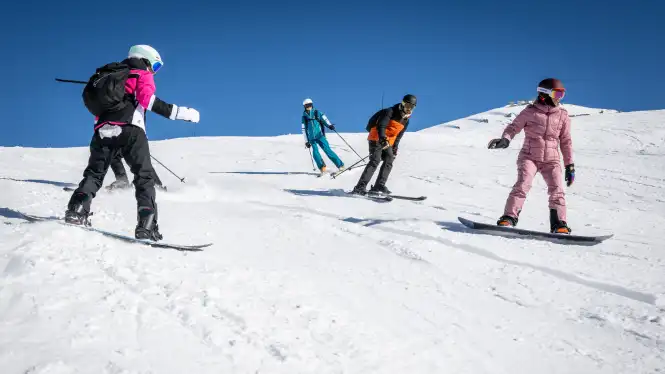
If you build a solid base of key skills, you can ride anything: One of the reasons for La Plagne’s enduring popularity is its abundance of wide, forgiving blue runs. Although blues are technically graded as intermediate, many of La Plagne’s are well within reach of cautious novice skiers and snowboarders.
The key is having solid base skills before venturing further afield — especially being able to sideslip in control. At a minimum, this gives you a safe way down if a section feels steeper or busier than expected.
If you look at the piste map, you’ll notice that most of La Plagne is graded blue. In many cases the grading is quite flattering compared to other resorts, so improving beginners can handle a large proportion of the terrain without issue. That said, there are a few exceptions, notably the top of the Mira blue, the start of Verdons and the bottom of Trieuse into Plagne Bellecôte.
Another thing to bear in mind is that many La Plagne blues are fairly shallow. If you don’t carry speed from steeper sections, you may find yourself poling or unclipping on the flats. We’ve highlighted the most common problem runs in our La Plagne pistes to avoid guide.
Finally, no matter how confident you feel, a lesson will always help. Practice is vital, but practising the wrong things just locks in bad habits that are harder to fix later. Even confident beginners benefit from the occasional lesson — especially if you only ski once a year.
Best improving beginners areas
Plagne Centre, Villages and Soleil
Mellow, wide pistes – perfect for improving beginners: La Plagne’s central area is packed with friendly blue pistes that are ideal once you’ve moved beyond greens. Runs off the Colorado and Bergerie chairs are particularly popular for improving beginners, although they can be busy at peak times. If your skills are ready, the Funiplagne opens up even more options across the sector (although the top section of Mira can be intimidating for novice riders). Take a look at our Best Plagne Centre Blue Runs page for further information.
Plagne Bellecôte and Belle Plagne
Improving riders are spoiled for choice in the Bellecôte valley: The Bellecôte bowl is dominated by blue pistes, making it ideal for confident beginners. The Arpette chair gives access to a huge choice of runs, while the Blanchets chair is usually quieter and better for relaxed progression. Belle Plagne shares many of the same forgiving routes. Check our Bellecôte Best Blue Runs page for more details.
Plagne Aime 2000
Aime 2000 – a great, high plateau area, perfect for dialing skills: Aime 2000 is one of the strongest areas in La Plagne for improving beginners. The Golf blue run in particular has an ideal incline for learning how to confidently link turns properly, and the area feels open and confidence-boosting. It’s also conveniently close to bars and restaurants once you’re done for the day. Our Best Blue Runs in Aime 2000 has more information.
Plagne 1800
Plagne 1800 – not much locally but a good base starting point: As there are only a couple of nearby blue runs around Plagne 1800, improving beginners will usually want to move out towards Aime 2000, Plagne Villages / Plagne Soleil or Plagne Centre. The Mélézes and Plagne 1800 chairs make it easy to link into these areas which have more forgiving progression routes.
Plagne Montalbert
Plagne Montalbert – snaking blue pistes between the trees: Montalbert is a brilliant choice for confident beginners, especially when visibility is poor. Most of the blue pistes can be accessed from the Montalbert gondola, and the tree-lined runs help with contrast and confidence. Most importantly, the tougher reds are easy to avoid.
Montchavin, Champagny and La Roche
Long blues, great views, quieter pistes: Montchavin is home to La Plagne’s longest blue run (the Mont Blanc), making it a great sector for confident beginners who want to cover distance. Champagny offers superb cruising blues off the Rossa chair (probably the best improving beginner runs in all of La Plagne), while La Roche riders will progress more by heading higher towards the Aime 2000 sector.
Next? See the best of La Plagne on (mostly) blue pistes
Once you’ve built your skills and are feeling more confident, you could try this route to see the best of La Plagne in a single day on mostly blue runs. IMPORTANT: You’ll need to be comfortable turning both ways, know how to control your speed and be able to stop without issues to do this route. If you have the skills, this is a great way to see La Plagne but do not attempt it until at least your third or fourth day of lessons and until your instructor gives you the go.
Plan your trip
More La Plagne travel resources: These partners help with booking, transfers and kit hire. We may earn a commission if you use them – at no extra cost to you.
La Plagne Geneva flights
More La Plagne flights